Stay Compliant & Protected: A Simple Guide to OIG Screening and Sanction Checks in 2024
- venops431
- 6 days ago
- 3 min read

If you work in the healthcare industry in the United States, you’ve likely heard the terms “OIG Screening” or “Sanction Checks” floating around. While they might sound like just more paperwork, they are actually your organization’s strongest shield against massive fines and legal headaches.
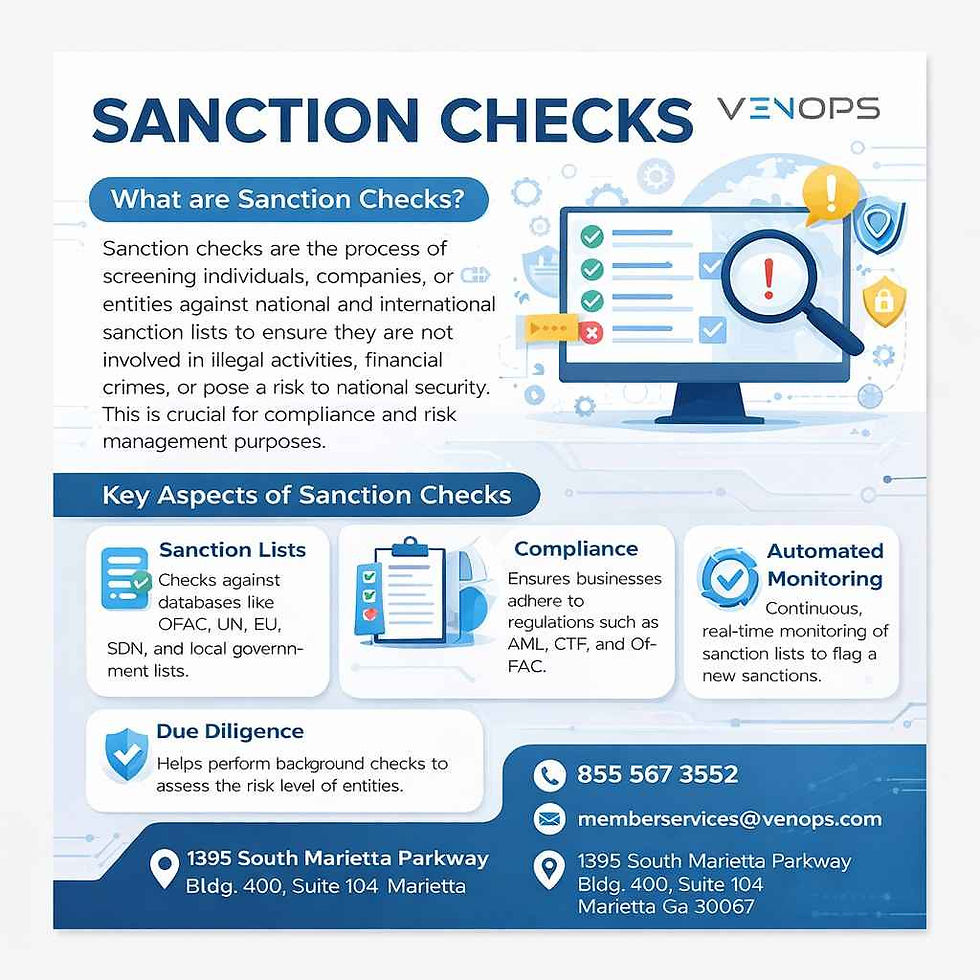
But what do they actually mean, and why is everyone talking about them right now? Let’s break it down in plain English.
What is OIG Screening? (The "No-Fly List" of Healthcare)
Think of the OIG (Office of Inspector General) as the watchdog for healthcare programs like Medicare and Medicaid. Their job is to make sure taxpayer money isn’t going to people or companies that have committed fraud or provided poor patient care.
The OIG maintains a list called the LEIE (List of Excluded Individuals and Entities). If a person or business is on this list, they are "excluded." This means:
They cannot work for any business that receives federal healthcare funding.
The government will not pay for any items or services they provide.
OIG Screening is simply the process of checking your current and future employees against this list to make sure they aren't on it.
What are Sanction Checks?
While OIG screening focuses on the federal level, Sanction Checks are a bit broader. They involve looking at various databases (including state-level lists and the System for Award Management or SAM) to see if a professional has had their license revoked, faced disciplinary action, or been barred from government contracts.
Why Does This Matter Right Now? (Trending for 2024)
Staying compliant isn't just about following rules; it’s about keeping up with the latest shifts in the U.S. healthcare landscape. Here is what is trending in the world of compliance today:
1. The Crackdown on Telehealth Fraud
Since the pandemic, telehealth has exploded. However, the OIG has recently ramped up its audits of telehealth providers. They are specifically looking for "telefraud" schemes where excluded individuals are hiding behind digital platforms. If you are hiring remote staff, OIG Exclusion screening is more critical than ever.
2. Rising Fines (Inflation-Adjusted)
The cost of a mistake is going up. In 2024, the Civil Monetary Penalties (CMP) for hiring an excluded individual have increased due to inflation adjustments. You could be fined over $20,000 for every single item or service claimed by an excluded person, plus triple the amount of the original claim.
3. Focus on Nursing Homes and Long-Term Care
The Biden-Harris administration recently introduced stricter staffing and oversight requirements for nursing homes. Part of this involves more rigorous background and exclusion checks to ensure patient safety. If you operate in the long-term care space, the OIG has you under a microscope this year.
4. Continuous Monitoring vs. Annual Checks
The old way of doing things was to check an employee once when they were hired. The new trend is monthly monitoring. Because the OIG exclusion updates its list every month, a "clean" employee in January could be "excluded" by March. Waiting until next year to check again could leave you with months of liability.
How to Stay Safe: 3 Simple Steps
Check Everyone: Don't just check doctors and nurses. Check your billing staff, IT team, and even third-party contractors. If they contribute to a service that is billed to the government, they need to be screened.
Screen Monthly: The OIG explicitly recommends monthly checks to coincide with their database updates.
Document Everything: If you get audited, "we checked it" isn't enough. You need time-stamped logs proving that you screened your staff against the LEIE and other sanction lists.
The Bottom Line
OIG screening and sanction checks might feel like a chore, but they are essential for a healthy healthcare business. By staying on top of your monthly checks, you aren't just avoiding fines—you’re ensuring that your patients are in the hands of trustworthy, qualified professionals.
Is your team up to date? If you haven't run a check in the last 30 days, now is the perfect time to start!


Comments